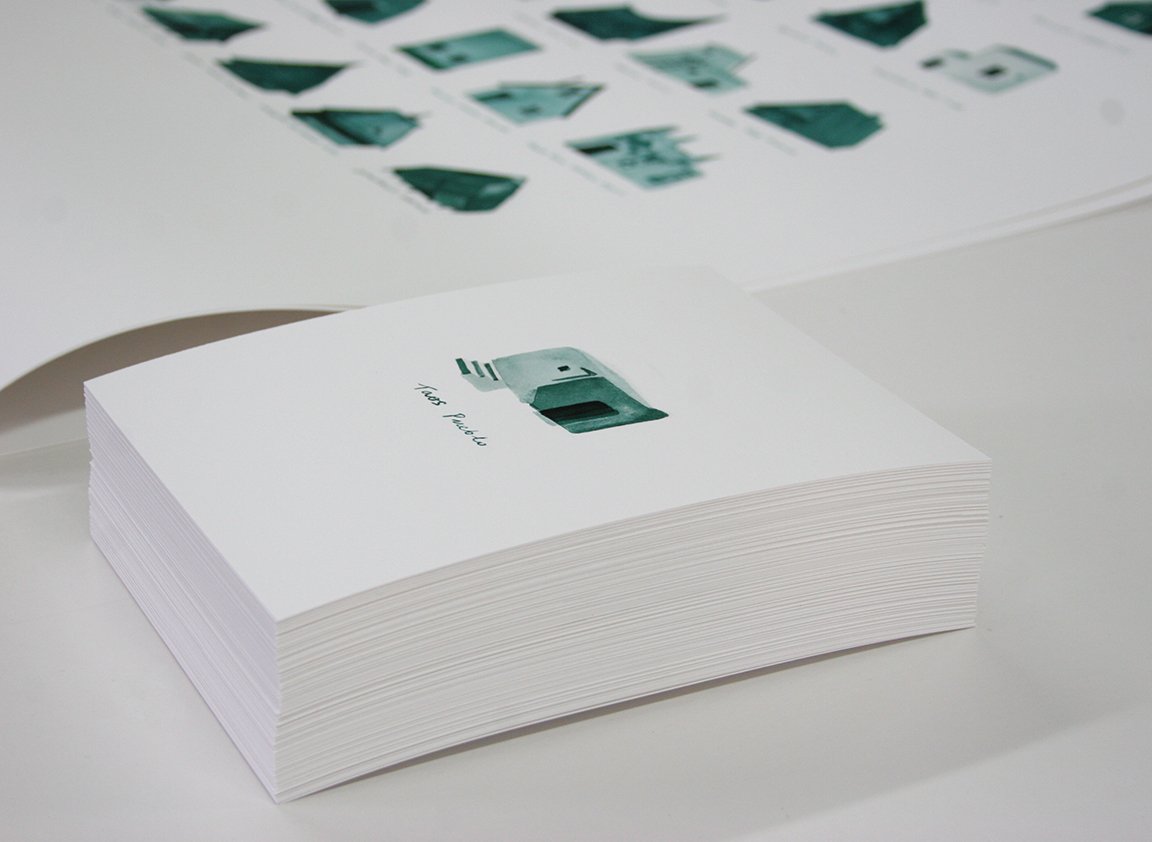
fine art printing and digitisation at its best
Professional fine art printing using top-of-the-range giclée printing technology. I’ve carefully selected a range of beautiful archival papers from the best paper mills in the world.
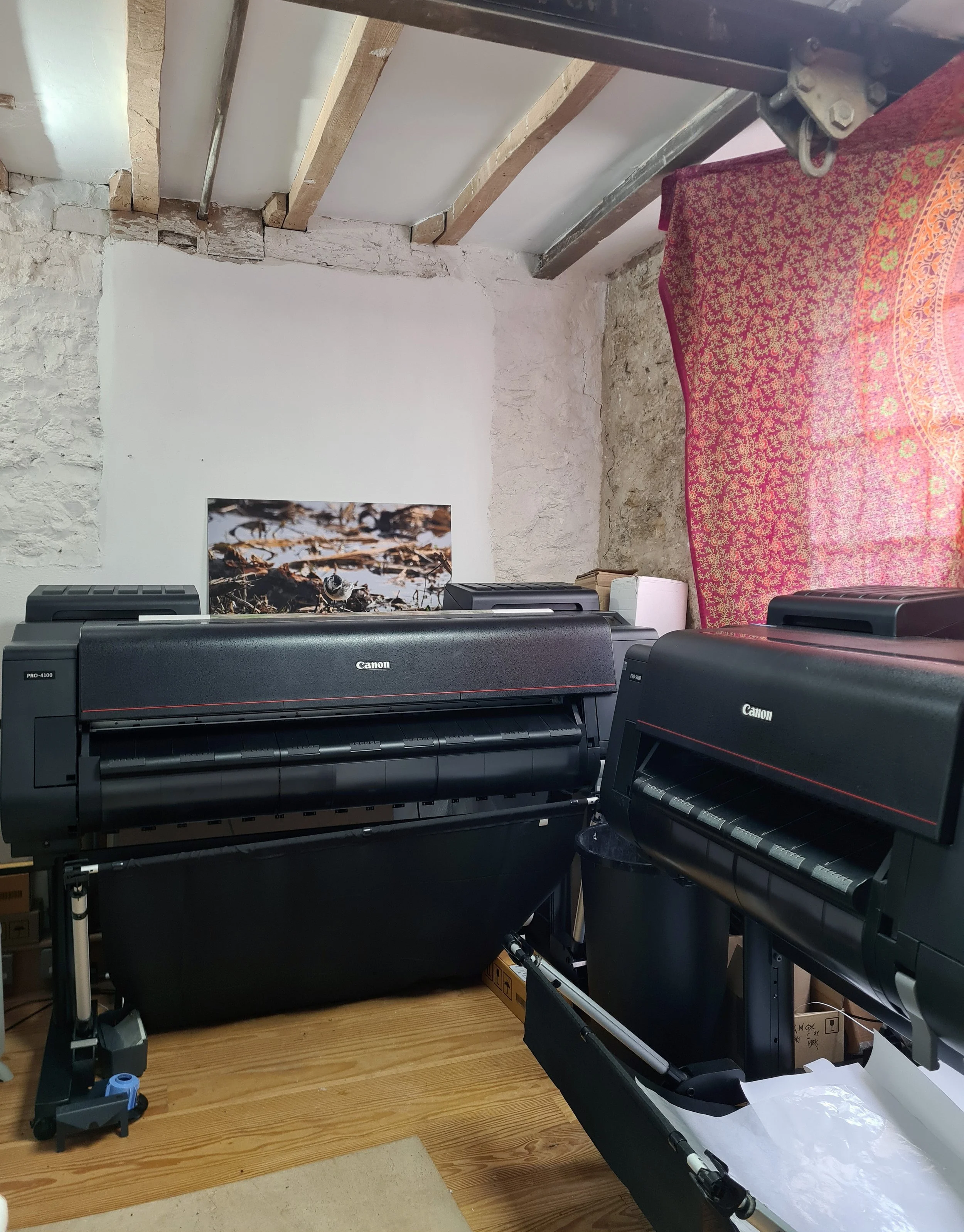
The printers
I run two printers, a 24 inch Canon Pro-2100, which can print up to A1, and 44 inch Canon Pro-4100, which can print up to 44” on the short edge (A0+). This system has 12 lucia pigment inks, with the widest colour gamut available, meaning it can faithfully reproduce artwork and photographs as true to the original colour as can be.

The papers
I’ve been printing professionally for 11 years, and in that time I’ve used lots of different papers. For Peradam I’ve selected my top 10 - from the most environmentally-friendly giclee paper available (Hahnemühle Hemp), to the exquisitely-produced Awagami Inbe washi.
If there’s a paper you want to print on that’s not in my selection I’ll probably be able to get hold of it, subject to minimum orders. I love to collaborate with artists on creative projects, so don’t be afraid to ask about off-menu options.

Scanning & digital imaging
I use a high resolution Epson flatbed imaging scanner that can capture original artworks up to A1 in glorious detail. It’s also capable of film and slide scanning.
I’ve been scanning professionally for longer than I’ve been printing. My first job after graduating from my photography BA was at Cambridge University’s Scott Polar Research Institute, where I digitised their collection of polar photographs. Since then I’ve scanned countless original artworks, personal archives, and historic and institutional collections including works from the Drawing Matter archive, Frome’s Singer foundry, The Newt, and Hauser & Wirth Somerset.
If you have an archive or collection that you want to digitise, I may be able to bring my scanning-gear to your archive and work from there to avoid the impact of transporting your collection out of its controlled environment.
FAQs
-
Giclee printing uses pigment-based inks sprayed onto archival coated papers. Giclee prints last decades or even centuries without fading if cared for properly. The process uses 12 ink colours to reproduce artwork in as true colour as is possible.
vs Litho or CMYK printing:
Mass-market art prints are often made with this process because when ordered in bulk the price per print can be cheap as chips. But they’re expensive if you’re only ordering one or two.
CMYK printing uses four colours rather than the 12 that giclee has, meaning giclee prints reproduce colour much more accurately.
Giclee printing is high-resolution, which gives the sharpest detail, and the deepest blacks.
CMYK prints aren’t archival, and will fade or yellow over time.
CMYK can be a good option for greetings cards, since cards aren’t intended to last decades, and they don’t need to be as colour-accurate as art prints.
vs C-type:
C-type prints are chemical-based, exposing paper to light in the same process as you’d use in a traditional darkroom (commercial print labs have big fancy machines that can do it very efficiently these days.) The tonal value of c-type is excellent, whereas giclee prints have a punchier saturation for brighter and denser colours.
C-type has a more limited selection of papers than giclee printing, but given its excellent tonal-range, it can be a good option for photographers to go for, since that’s what the process lends itself to.
Giclee is more archival than c-type prints, which are more sensitive to light, so will eventually fade or lose their colour accuracy.
I don’t currently offer C-type printing.
If you’re after CMYK printing, I have a good relationship with a printer who share my ethos. I’m happy to organise this for you.
If you just need a boarding pass or other document printed, you're better off going to a copy shop: Postscript in Frome are an excellent choice.
-
Please contact me here:
Alternatively you can try my new order form for a discount on set-up fees:
-
If you need it quickly, let me know and I’ll do my best to turn the job around for you within your deadline.
Otherwise, please see below for my general turnaround. click here
-
Please see my file spec guide
-
I wrap prints in recyclable tissue paper to protect the ink from marking. But this is the only packaging I provide. I only have a tiny studio, so I can’t accommodate stocks of packaging material, and I’d rather not provide unnecessary things that will just be thrown away.
Please bear this in mind when collecting your prints, and ensure you bring a water and wind proof method of taking your prints home with you.
-
Giclee papers have a special invisible coating that stops the ink from bleeding out into the paper fibre. Using paper that’s not got this special coating will rinse through ink and the print heads, and ends up being a very costly business. For this reason I’ll only print with giclee papers. If there’s a giclee paper you have in mind that I don’t stock, I can probably get hold of it (subject to minimum orders and longer turnarounds).
See my current paper selection.
-
We can deckle edges, but we request that new customers requiring this service contact us about your specification. Please note that the first order may have a longer turnaround than normal. Fire me an email about it via this link.
-
Handle the print as little as possible, and avoid touching the inked surface. Giclee ink can mark, particularly dark prints so please handle with care. When storing prints for any length of time make sure you use acid-free materials to wrap your print in (the tissue paper I supply prints in isn’t archival, and not intended to be used long-term). UV light will damage prints, so don’t keep in direct sunlight.
When framing and mounting, use acid-free and/ or conservation-grade materials, and never frame a print direct against glass without a window mount or spacer (this can generate condensation that will fuse the print to the glass). Acrylic can be used instead of glass if you don’t want to use a window mount or spacers.
Tube-rolled or curly prints
If rolled into a tube, best to carefully take it out and store it flat or get it framed straightaway - the longer the print stays in the tube the curlier the print will be.
Paper has a memory, and it will remember being rolled and want to return to that state. If your print is a bit curly then you can place heavy books on top (with a layer of tissue paper to protect the print) and it should flatten out.
Some papers can take being reverse-rolled, whereby you roll the paper over a tube in the opposite way to how it’s naturally curling. But this can damage some papers, so proceed with caution.
Textured paper, particularly German Etching, holds its memory of being rolled the most, and it is harder to reverse-roll without damaging the print. Bare this in mind when ordering, as I usually print from a roll rather than cut-sheets. I find Somerset Enhanced Velvet is the best textured paper for reducing this problem.
-
I have just introduced canvas printing, but I don’t stretch canvas. Local framers Studio Prints offer a canvas stretching service, I can put you in touch with them.
Alternatives
St Cuthbert’s Mill Somerset Enhanced Velvet makes a good paper alternative to stretched canvas, as the texture of this paper evokes a similar tactility to canvas.
-
Fine art scanning uses top of the range graphic scanning hardware combined with colour-management software to make high-resolution colour-accurate copies of artwork and original documents. You can read more about the specifications of my scanning system here: https://www.peradam.co.uk/extra-info/scanning
If you just need to copy a passport, driving licence or other document for purposes other than art reproduction, or you're not bothered about colour accuracy and tonal range then I recommend using a copy shop instead - Postscript in Frome have the right hardware to do this sort of scanning and do an excellent job.
-
I can reproduce artworks up to A1 size.
Anything larger than A1 will need to be professionally photographed. (My studio is too tiny to accommodate the kit for this, but contact me if you’d like a recommendation for where to get this done). -
You own the copyright to your original artwork, and to the scanned file. The file I create is yours - you’re welcome to just use my scanning service and then print the file elsewhere. I WeTransfer files to you, and it’s up to you to safely store them. I’ll keep your scans on my system for up to 3 months, after which time they’re subject to being deleted*. This means if you want to order prints of a file I’ve scanned for you, you’ll need to resend it to me.*
* unless you’re subscribed to my archival storage service (read more)
If I forget to WeTransfer you your files, please remind me. I won’t delete files that I haven’t transferred to you.
copyright of artwork you didn’t make yourself
It is up to you to get the necessary permission if you’re trying to reproduce artwork that you haven’t made yourself. Any copyright dispute that comes up as a result of a scan you’ve asked me to make legally falls on you, so I urge you to only make copies of work you own the copyright of, or that you have permission to copy.
-
My first graduate job was at Scott Polar Research Institute at Cambridge University, where I learned how to handle fragile artworks, glass negatives, and historic documents. So your collection is in safe hands.
If you have only a few items to digitise I recommend arranging for this to be on the day you bring the works to me, so that they are out of their archive for the shortest time possible. Best to contact me in this case and I can sort the logistics out.
For those who have a large number of works that need digitising, I may be able to come to your archive with my scanner and gear and make a run of it, working on a day rate rather than by the image.
-
There’s a more comprehensive FAQ at the bottom of the about page including openings hours.
some of my clients


“Great company, really friendly and very helpful in doing prints from a watercolour original. The colour was amazing and it was difficult to tell the print from the original.”
“I LOVE the colour…..spot on….thank you!”
“The quality of the prints is superb.”